Lately, I’ve embraced timeboxes to help manage some of the “noise” or mental overhead associated with adulting. For a while, I often found myself overwhelmed by an ever growing to do list for everything in life, and I often just didn’t know where to start. Staring at the list could often feel paralyzing. And even worse, it would give me the horrifying feeling that I would have to spend all of my evening and weekend non-work hours on tackling the list. (And then I’d spiral, pontificating on the point of adult life if all I had time for were work and chores.)

Dramatic as it sounds, I know I’m not the only one who’s found myself in this place of despair. As I stepped back to examine what I was doing, I realized that many of these tasks didn’t come with natural, obvious deadlines. As a result, I’d revisit the same task over and over again, often in five or ten minute increments (depending on attention span du jour), and I wouldn’t make any progress. I’d neither finish the task nor formulate a deeper opinion on how I wanted to proceed. Instead, I’d be stuck in this holding pattern—I thought I was making incremental progress when really, I was just zig zagging.
Examples:
I needed to buy flights for an upcoming trip. Nothing was stopping me from doing this other than a notion of “maybe it’ll get cheaper” or “maybe I can find a good deal with points.” I had dates, I knew which flights I wanted, etc. I’d endlessly refresh the points search engine and Google Flights, and I’d leave this task incomplete on my list for weeks.
I needed to purchase decorations for an upcoming party. I’d browse inspiration on countless websites, making my way from Pinterest to Instagram to Temu and back to Pinterest. I knew I needed to pick a theme and make a decision on budget, but instead, I was scrolling through option after option, not getting any crisper on my criteria.
I needed to choose a restaurant for dinner with friends. I scrolled from listicle to listicle, and onto Google Maps. I looked at all my starred restaurants. I starred more restaurants. I wasn’t getting any closer to actually deciding—the options were either to send a short list to the group or just make a reservation. I’d leave this incomplete and then go back to googling restaurants again the next day, often redoing the same steps.
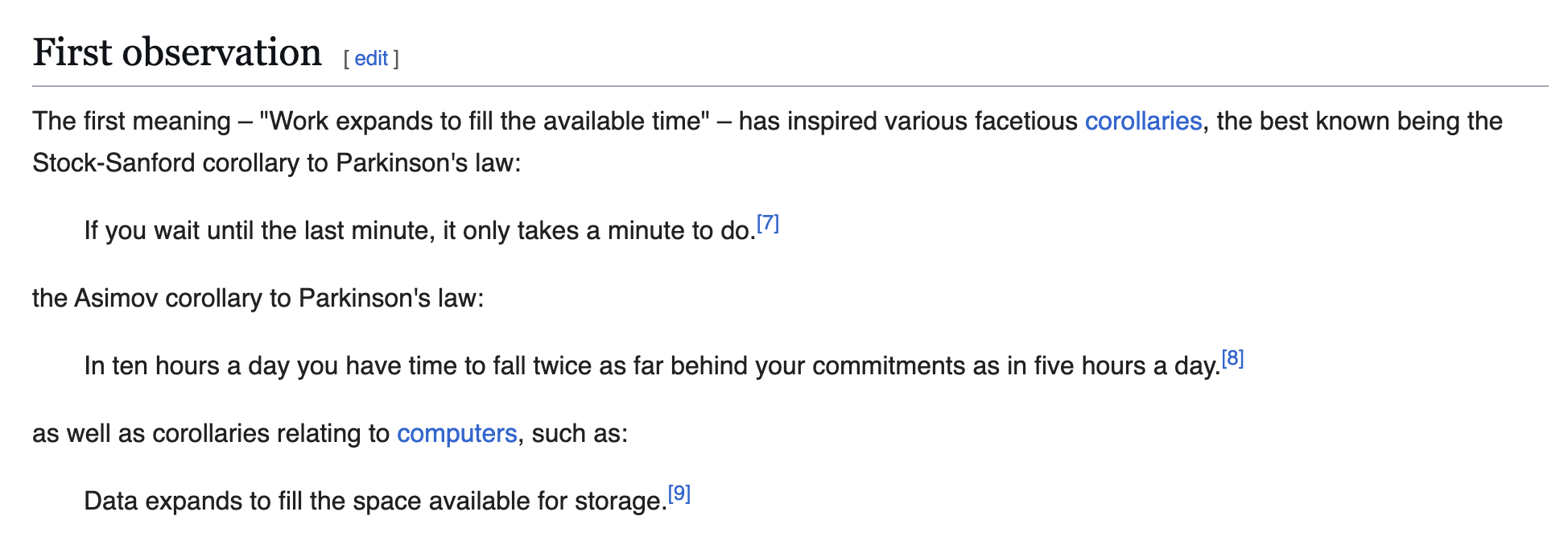
In many cases, I think I was falling victim to Parkinson’s Law, which states that “Work expands so as to fill the time available for its completion.”
There are some other handy ways to conceptualize this:
Once I realized this, I started to make some changes. I was most frustrated that I was randomizing myself with piecemeal progress (or “progress”) on a lot of tasks.
To stop wasting time, I started to set aside explicit time to do specific tasks. I realized that when they were on an infinitely long to do list, it was likely that they would not get done in an efficient way. Also, as a chronic over-planner, doing this gave me the mental safety of knowing that a future task was accounted for, and there would be time to tackle it, enabling me to not start on the task at an inappropriately early time.
Now when I triage my to do list, I break it down:
Recurring tasks get scheduled time each week in a small block. I don’t give myself too long to dilly dally and I aim to get things done quickly in that window.
One off tasks get scheduled time based on when they need to be done. I like to give myself some buffer so if I don’t feel like doing those tasks that day, I can move the block to another day. But this way, things get done in time without as much urgency or stress. I try to allot a few hours of time for one off tasks so I can get into the flow (and also this way, I can make an activity out of it—e.g. I can go to a cafe and camp out with my laptop to tackle one clear goal)
Certain tasks that might be optimized for two or more parts are broken down accordingly. I usually like to put big purchases in this category because it gives me time to reflect between making an initial selection and the final purchase.
I will say outside of setting up this structure, the hardest part of this model is not thinking about these tasks outside of these blocks. Sometimes, inspiration hits and I do some of the work in advance because I just can’t help myself—especially if it’s something I’m really excited about. In those scenarios, I triple check with my gut to make sure that it’s fun and I’m not just torturing myself. Once I’ve made some progress, I shorten the block of remaining time to account for the time I’ve already spent on the given task.
In general, this not only made me more efficient but also reduced my stress and frustration at myself for being inefficient. It’s gotten me out of a doom loop more than once, and I try to constantly remember that gaseous tasks cannot be treated like linear tasks, such as washing the dishes or brushing my teeth. (That said, there’s an important adjacency here, which is that successful timeboxing also entails not yak shaving.)
All in all, this is probably a classic overthink and overoptimize on my part—but hopefully helpful, perhaps for a work context if not personal.